
The Frustration of Acne Scars (And How to Finally Treat Them)
If you have ever battled acne, you already know that the final breakout is rarely the end of the story. Long after the active pimples and cysts have healed, you are often left with a frustrating reminder on your skin: acne scars. You did the hard work to get your breakouts under control, but now you are staring in the mirror at uneven texture, small indentations, or stubborn dark spots that just refuse to fade away.
When you start researching professional clinic treatments, you will inevitably run into the two gold standards of skin resurfacing: microneedling and chemical peels . Both of these treatments are incredibly popular, both are backed by decades of dermatological science, and both can dramatically transform your complexion. But when it comes to treating acne scars specifically, they are not interchangeable.
Choosing the wrong treatment for your specific type of scar can lead to wasted time, lost money, and in some cases, worse hyperpigmentation. So, how do you choose?
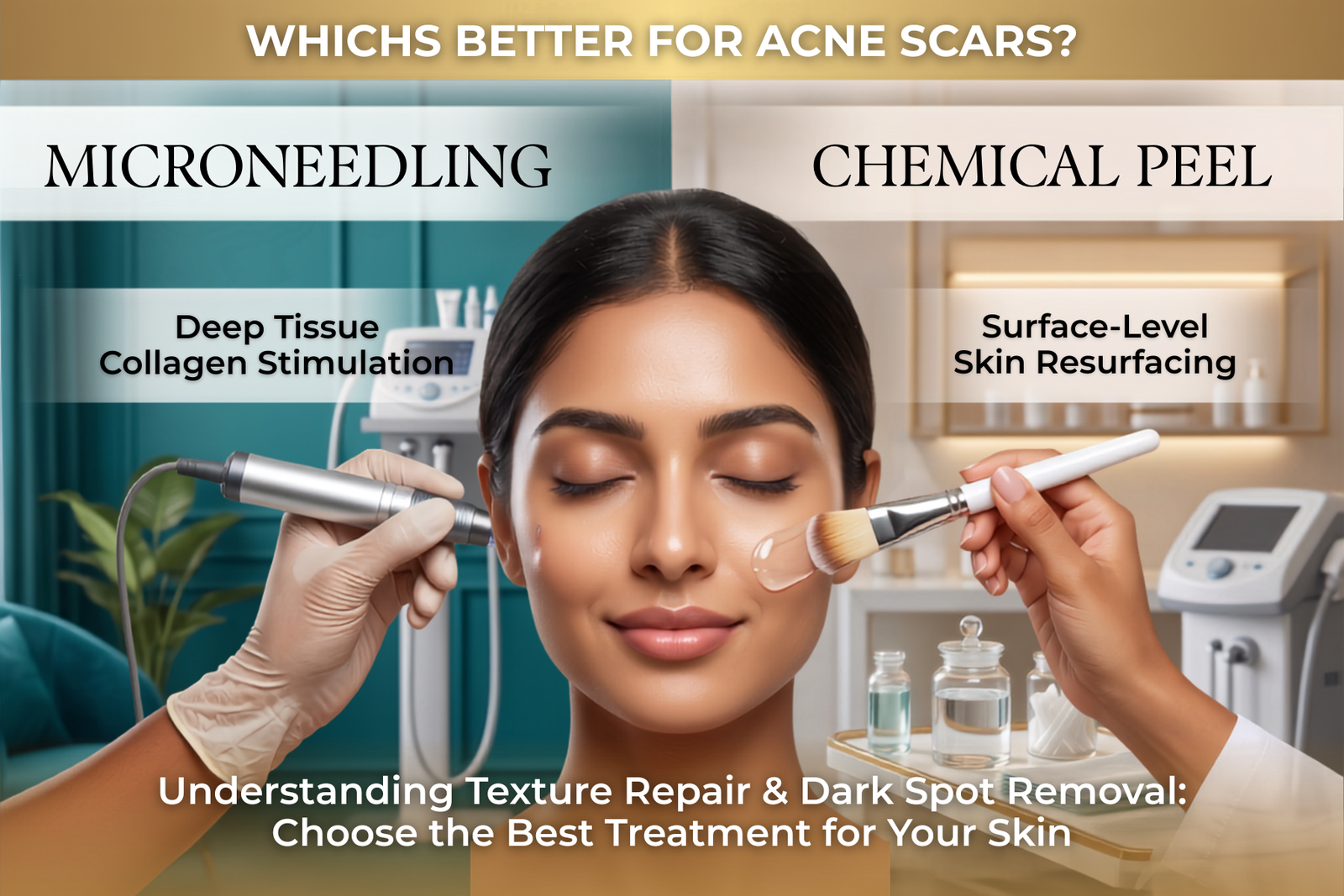
The short answer is this: Microneedling is generally better for fixing indented, textured scars, while chemical peels are superior for lifting away the dark and red marks left behind by past breakouts . However, human skin is rarely that simple. Most people have a combination of both texture and pigment issues.
In this comprehensive guide, we are going to break down exactly how microneedling and chemical peels work, what the treatment experience is actually like, and how to identify which path is the safest and most effective for your unique skin type.
Decoding Your Scars: Texture vs. Tone
Before you can choose a treatment, you have to know exactly what kind of “scar” you are dealing with In the dermatology world, we divide acne scars into two main categories: structural texture changes and pigment changes.
1. Textural (Atrophic) Scars
These are true physical scars. They occur when severe acne destroys the collagen deep in your skin. When the body tries to heal the area, it doesn’t make enough tissue to fill the gap, leaving a visible depression or pit. There are three main types of atrophic scars.
- Ice Pick Scars: These look exactly like they sound. They are narrow, deep holes that look as though the skin was punctured by a tiny sharp object.
- Boxcar Scars: These are broader depressions with sharp, defined edges. They look a bit like a shallow, tiny crater on the skin.
- Rolling Scars: These scars have smooth, sloping edges that make the skin look wavy or uneven, especially under harsh overhead lighting.
2. Pigment Changes (False Scars)
Many people think they have acne scars, but what they actually have is post-acne discoloration. Because the skin isn’t physically indented, these are not true scars, but they can be just as annoying to deal with.
- Post-Inflammatory Hyperpigmentation (PIH): These are flat, dark brown, or black spots left behind after a pimple heals. This happens when the inflammation from the acne causes your skin to overproduce melanin (pigment).
- Post-Inflammatory Erythema (PIE): These are flat red, pink, or purple spots. They are caused by damaged blood vessels near the surface of the skin after an inflamed breakout.
If you run your finger over your skin with your eyes closed and feel bumps or dips, you have textural scars. If your skin feels completely smooth but you see dark or red marks, you have pigment changes.
Microneedling: The Champion of Texture Repair
Microneedling, formally known as Collagen Induction Therapy, is arguably the most effective non-surgical treatment for actual, indented acne scars.
How It Works
Instead of removing the top layer of your skin, microneedling works by tricking your body into healing itself. A licensed professional uses a medical-grade device (like a SkinPen) equipped with dozens of microscopic, sterile needles. As the device glides across your skin, it creates thousands of controlled, invisible micro-injuries deep in the dermis the foundational layer of your skin.
Your body registers these micro-injuries and immediately goes into repair mode. It rushes blood flow to the area and, most importantly, starts pumping out massive amounts of fresh collagen and elastin. Collagen is the protein responsible for keeping our skin firm, plump, and smooth. Over the course of several weeks, this surge of new collagen physically pushes up from the bottom of the scar, slowly filling in the pits and craters until they are much closer to level with the surrounding skin.
For severe scarring, clinics often use Radiofrequency (RF) Microneedling. This delivers heat energy through the needles directly into the deep layers of the skin, shrinking old, damaged tissue and triggering an even stronger collagen response.
Clinical data strongly supports this method. A notable 2022 study from Rutgers University found that over 73% of patients treated with microneedling saw significant, meaningful improvement in their acne scars.
The Treatment Experience
Before the treatment begins, your provider will apply a strong topical numbing cream to your face for about thirty minutes. Because of the numbing, the actual needling process is generally very comfortable. You will feel pressure and a slight vibrating sensation, but pain is minimal.
Immediately afterward, your face will be quite red similar to a moderate sunburn. This redness usually fades within 24 to 48 hours. Your skin will feel tight and dry for a few days, but there is no actual “peeling” of sheets of skin.
Pros of Microneedling
- Highly Effective for Deep Scars: It is the premier choice for rolling and boxcar scars because it rebuilds the skin from the inside out.
- Safe for All Skin Tones: Because it does not use heat (in traditional microneedling) or harsh chemicals, it is incredibly safe for medium to dark skin tones, carrying a very low risk of causing hyperpigmentation.
- Long-Lasting Results: The collagen your body builds is yours to keep. Results are permanent, though you will still age naturally over time.
- Shorter Downtime: Compared to deep skin resurfacing, a day or two of redness is very manageable for most working adults.
Cons of Microneedling
- Patience is Required: Because you have to wait for your body to grow new collagen, you will not see results overnight. It takes three to six sessions, spaced a month apart, to see a dramatic transformation.
- Not for Active Acne: You cannot undergo microneedling if you currently have inflamed, active pimples. The needles can spread the acne bacteria across your face, causing a massive breakout.
- Doesn’t Target Redness Well: While it helps slightly with cell turnover, it is not the best primary treatment for purely red marks (PIE).
Chemical Peels: The Eraser of Dark Marks
If your primary concern is dark spots, dullness, and lingering hyperpigmentation from past breakouts, chemical peels are usually the fastest route to clear skin [4].
How It Works
A chemical peel relies on specialized acid solutions to chemically exfoliate the skin. The acid is carefully applied to your face and left on for a specific amount of time. The solution works by dissolving the microscopic “glue” that holds dead, damaged, and heavily pigmented skin cells together.
Once that glue is melted, the top layers of the skin eventually peel away, revealing the fresh, smooth, and evenly toned skin hiding underneath.
Peels come in different depths:
- Superficial Peels: Usually made of Glycolic acid (an AHA) or Salicylic acid (a BHA). These only penetrate the very top layer of the skin. They are fantastic for fading mild dark spots and clearing out clogged pores to stop future breakouts.
- Medium Peels: Often using TCA (Trichloroacetic acid). These reach slightly deeper into the skin and are excellent for stubborn, long-lasting hyperpigmentation and very mild surface texture.
- TCA CROSS: This is a highly specialized technique where a doctor places a tiny drop of very strong acid directly inside a deep ice-pick scar. It causes a localized scab, which prompts the narrow hole to close up as it heals.
The Treatment Experience
Unlike microneedling, peels do not usually require numbing cream. When the acid is applied, you will feel a warm, tingling, or stinging sensation that lasts for a few minutes. Most clinics will use a small handheld fan to blow cool air on your face to keep you comfortable.
The downtime depends entirely on the strength of the peel. A light peel might just make your skin look a little flaky for two days. A medium peel will cause your skin to feel tight and turn brown, followed by three to seven days of visible, snake-like skin peeling.
Pros of Chemical Peels
- Fast Brightening: You can often see a noticeable improvement in skin brightness and the fading of dark marks after just one single session.
- Treats Active Acne: Unlike microneedling, certain peels (like Salicylic acid) are incredible for stopping active breakouts. They dive deep into the pores to clear out oil and acne-causing bacteria.
- Excellent for Hyperpigmentation: Nothing clears away brown spots and post-inflammatory hyperpigmentation faster than peeling away the pigment-heavy cells.
- Improves General Glow: Peels leave the skin looking incredibly radiant and glassy by removing the dull buildup on the surface.
Cons of Chemical Peels
- Ineffective for Deep Scars: Most peels cannot reach deep enough into the dermis to rebuild the collagen needed to fill in boxcar or rolling scars. The Rutgers study mentioned earlier showed only a 33% improvement rate in deep scars using glycolic peels.
- Tougher Downtime: Deep peeling can be socially awkward. You cannot wear makeup over peeling skin, and you must avoid sun exposure completely.
- Higher Risk for Darker Skin: This is a critical factor. Medium to deep chemical peels carry a high risk of causing post-inflammatory hyperpigmentation (PIH) in people with olive, brown, or dark skin tones. The controlled chemical burn can trigger the skin’s pigment cells to panic and overproduce melanin.
The Crucial Factor: Skin Tone and Safety
If you have a deeper skin tone (Fitzpatrick skin types IV through VI, which includes many Asian, Hispanic, and Black skin tones), safety must be your top priority. Darker skin is rich in melanocytes the cells that produce pigment. When these cells are exposed to the heavy inflammation and heat caused by medium or deep chemical peels, they can react by dumping excess melanin into the skin.
This means a chemical peel intended to fix a few dark spots could accidentally leave you with much larger, darker patches of hyperpigmentation.
Because of this, microneedling is overwhelmingly preferred by dermatologists as the safest option for treating textured acne scars in darker skin. Microneedling bypasses the surface pigment layer entirely, working deep underneath the skin to build collagen without triggering those pigment-producing cells. If you have a deeper skin tone and want to treat dark marks, your provider will likely recommend very gentle, superficial peels or alternative brightening serums rather than aggressive peeling.
Combining Treatments: The Ultimate Approach
If you are looking in the mirror and realizing that you have both indented scars and dark hyperpigmentation, you are not alone. This is incredibly common. The good news is that you don’t actually have to choose just one treatment.
In fact, the absolute best results come from combining the structural repair of microneedling with the surface-level perfection of a chemical peel.
However, you cannot do both on the exact same day. If you apply a strong chemical acid to skin that has just been pierced with thousands of micro-needles, the acid will travel far too deep, causing severe chemical burns and permanent damage.
Instead, professional clinics will create a staggered treatment plan for you. A standard approach is to alternate treatments every few weeks. For example, you might have a microneedling session to stimulate deep collagen repair. Then, three or four weeks later, once the skin barrier has fully healed, you come in for a light chemical peel to sweep away the dark spots and polish the surface. This alternating schedule ensures you are tackling the scars from both the inside out and the outside in, yielding truly transformative results.
Making Your Final Decision
Dealing with acne scars can feel overwhelming, but you have highly effective options available.
If your fingers catch on dips and craters when you touch your skin, you need the heavy lifting and collagen-building power of microneedling. It is a safe, highly effective, and long-lasting way to smooth out your skin’s foundation.
If your skin feels mostly smooth, but you are plagued by dark spots, dullness, or even some lingering active breakouts, a chemical peel is going to give you the beautiful, bright, even-toned complexion you are looking for.
Ultimately, the best first step is to stop guessing. Acne scarring is complex, and over-the-counter serums will only take you so far. Book a consultation with a licensed aesthetic professional or a board-certified dermatologist. They will be able to map out your specific scar types, evaluate your skin tone safety profile, and design a customized treatment timeline to finally give you the clear, smooth skin you deserve.

